How Obligo Is Applying AI to Security Deposit Compliance

Obligo's mission is to build and protect trust between renters and property managers by modernizing one of the most burdensome parts of the rental experience: security deposits. That trust is often won or lost during move-out, when property teams must demonstrate that any charges are fair, well-documented, and compliant with the law.
For years, Obligo has built products that reduce friction throughout the move-out process. Now, we're applying AI to help property managers review move-out cases more efficiently, consistently, and accurately - while giving teams better tools to protect renter trust at one of the most sensitive moments in the lease lifecycle. The Obligo Deposit Agent will provide a case-specific recommendation for the property team to review, but keeps the final decision with the property manager. Read the full blog to learn more about how.
The Move-Out Documentation Challenge
The hardest part of move-out isn't deciding whether to assess charges, it's validating them.
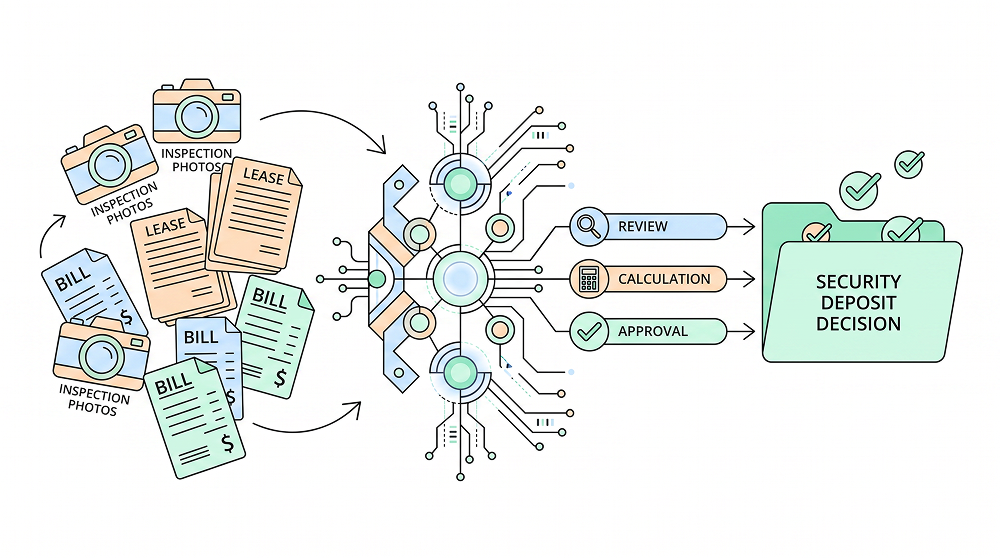
A single move-out case can include a lease agreement, account ledger, move-out statement, vendor receipts, inspection photos, and itemized deductions. These documents often come from different systems, in different formats, and contain mostly unstructured information.
To validate a single charge, someone may need to connect information across multiple documents while also determining whether the charge is permissible under the lease and compliant with the rules that apply to that specific property. Those requirements can vary by state, city, and county, and change over time. Keeping every case aligned with the latest requirements is a significant operational challenge - and the cost of getting it wrong can be substantial, with some operators facing multimillion-dollar settlements tied to security deposit practices. Multiply that complexity by hundreds or thousands of move-outs each year, and the challenge quickly becomes one of data management and consistent execution, not simply legal knowledge.
Property managers understand the rules. The real difficulty is applying them consistently across every case, under tight statutory deadlines - without turning move-out review into a slow, manual process.
An AI Workflow Built for Move-Out Cases
To solve this problem, we're developing an agentic AI workflow purpose-built for security deposit compliance.
The Obligo Deposit Agent reviews the documentation associated with a move-out, organizes it, extracts key information, and prepares it for compliance review. Rather than serving as a general-purpose AI assistant, it's being built around years of Obligo's experience managing properties’ security requirements across the United States, where documentation requirements, allowable deductions, and refund timelines vary by jurisdiction.
We're also designing the experience for real-time interaction. That's a meaningful technical challenge: some agentic tasks require multiple steps, document comparisons, retrieval, and validation before a reliable answer can be produced. The goal isn't simply to make the system fast; it's to make complex AI workflows feel responsive to property teams without sacrificing the accuracy and traceability required for compliance-related work.
How It Works
The workflow will combine AI, retrieval-augmented generation (RAG), and deterministic, rule-based validation, allowing each technology to do what it does best.
AI is responsible for tasks such as:
- Classifying incoming documents, such as receipts, ledgers, inspection reports, and move-out statements
- Extracting key information, including dates, amounts, vendor names, and line items
- Validating extracted data against the case by matching renter information, addresses, and timelines
- Categorizing deductions and linking related documents together
Each AI step produces a focused, verifiable result rather than asking one model to evaluate an entire case at once. This modular approach improves both accuracy and transparency.
Learning From Similar Move-Outs With RAG
A key part of the architecture is retrieval-augmented generation, or RAG. Instead of asking the AI to perform each task using only a general model and the documents in front of it, Obligo can retrieve relevant examples from previously reviewed move-out cases and provide them as additional context.
For each AI task, the system can use vector search to identify a set of similar examples - based on the type of document, deduction, supporting evidence, or other characteristics of the case. Those examples help the model recognize how information and supporting documentation were organized in comparable situations before producing its response.
This creates an important feedback loop. As Obligo processes more move-outs and encounters more real-world edge cases, the library of useful examples grows. The underlying model isn't retrained after every case, but the context available to it becomes richer and more relevant. In practice, that means the system can become more effective as it sees a broader range of move-out scenarios.
Where The Rules Take Over
Once the information has been organized, it moves into a deterministic rules engine that evaluates compliance based on:
- Applicable security deposit laws
- Obligo's documentation and charge-review guidelinese
- Property-specific policies defined by individual management companies
This separation is intentional. AI excels at interpreting messy documents and converting them into structured data. Compliance review, however, requires consistency and explainability. Rule-based systems help ensure the same facts are evaluated against the same requirements, with recommendations traceable back to the relevant rule. The operational value goes beyond reducing compliance risk: a more standardized move-out process can help prevent avoidable renter disputes while also helping property teams review proposed charges for completeness, supporting documentation, and consistency with applicable requirements.
Simply put: AI reads and organizes the evidence. Retrieval provides relevant precedent. Rules evaluate the requirements. The Obligo Deposit Agent then provides a case-specific recommendation for the property team to review, with the final decision remaining with the property manager.
AI That Supports Compliance
The Obligo Deposit Agent is not designed to replace property managers or make legal decisions on their behalf.
Property managers remain responsible for their documentation, resident relationships, and final decisions. The goal is to provide an intelligent second set of eyes - one that can identify missing documentation, inconsistencies, or potential compliance issues before they become resident disputes.
This reflects Obligo's broader philosophy around AI and our mission to build trust in the rental relationship: technology should make complicated processes more transparent, consistent, and fair for both sides. AI is most valuable here when it strengthens human decision-making rather than obscuring it.
By helping teams review cases more consistently and catch issues earlier, AI can improve operational efficiency while strengthening trust between renters and property managers.
What's Next
We're actively refining this workflow and testing it against real-world move-out cases.
Because every property, document set, and jurisdiction introduces unique edge cases, accuracy is more important than speed. At the same time, we're working toward an experience that can support property teams in real time, even when the underlying agentic workflow requires multiple steps to reach a reliable result.
Early versions of this workflow are already being used and tested in real-world scenarios, giving us the opportunity to learn from actual move-out cases and continue refining the experience. As we move into 2027, we expect to put these capabilities in the hands of more customers while continuing to validate them across a wider range of portfolios, documentation patterns, and regulatory environments.
As AI continues to evolve, we believe its greatest value isn't replacing expertise - it's helping experienced teams apply that expertise more consistently, accurately, and at scale. And as the system encounters more move-outs, retrieval can help turn that growing body of experience into better context for the next case.
Disclaimer: This article is intended for general informational purposes only and is not legal advice. Security deposit laws vary by jurisdiction and may change over time. You should consult qualified legal counsel before relying on any information regarding legal compliance.